Who Builds the Actuator? Inside the Global Supply Chain of Every Robot Joint
A single robot joint depends on specialized components from at least five countries. No single nation — including China or the US — can produce a complete actuator from raw materials alone.
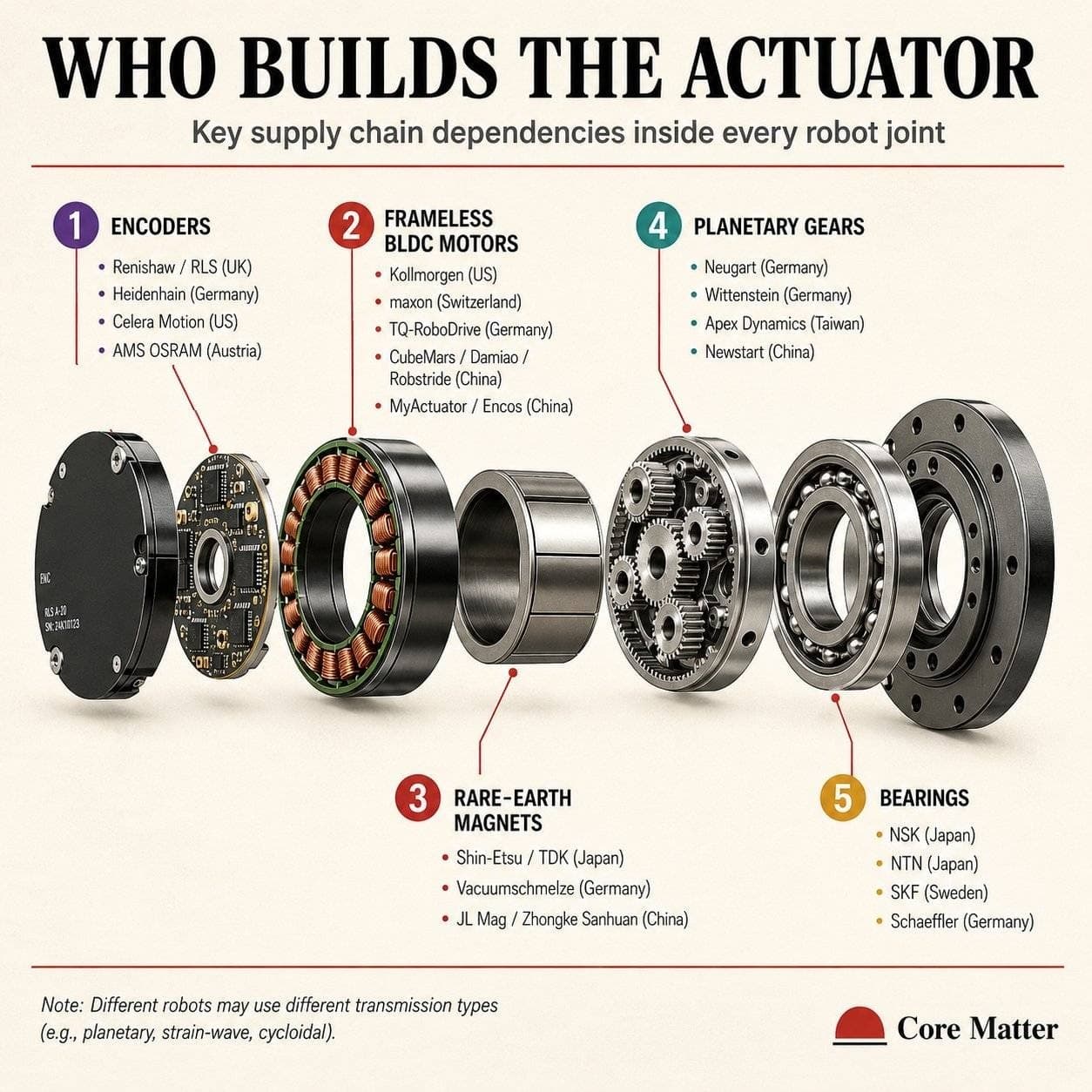
Source: Core Matter — Exploded view of a robot rotary actuator showing five critical component categories
The Anatomy of a Robot Joint
Every humanoid robot, industrial arm, or collaborative robot relies on rotary actuators — the motors that drive each joint. Behind what looks like a single integrated component lies a complex global web of suppliers, each dominating a specialized niche.
The infographic above, originally published by Core Matter, breaks down the actuator into its five critical subcomponents and maps the key manufacturers behind each one.
Five Critical Components, Five Different Supply Chains
Encoders
The "eyes" of the motor — precision sensors that measure rotor position and speed. Without accurate feedback, the robot cannot control its movements.
Frameless BLDC Motors
The core electromagnetic drive — stator and rotor without housing, designed to be integrated directly into the joint. High torque density is the competitive moat.
Rare-Earth Magnets
The invisible force — neodymium magnets embedded in the rotor that create the magnetic field. This is where China holds the most leverage, controlling ~60% of global rare-earth processing.
Planetary Gears
The torque multiplier — precision gearboxes that reduce motor speed while increasing output torque. German engineering dominates this segment, though Chinese firms are rapidly closing the gap.
Note: Some robots use strain-wave (harmonic) or cycloidal drives instead of planetary gears.
Bearings
The silent workhorse — precision bearings that allow smooth rotation under load. Japanese and European manufacturers dominate this century-old industry.
Geographic Dominance Map
Investment Implications
The robotics supply chain presents a unique investment opportunity: picks-and-shovels plays benefit regardless of which robot OEM wins the humanoid race.
Disclaimer: Artikel ini bersifat informatif dan bukan merupakan rekomendasi investasi. Selalu lakukan riset mandiri sebelum mengambil keputusan investasi.